
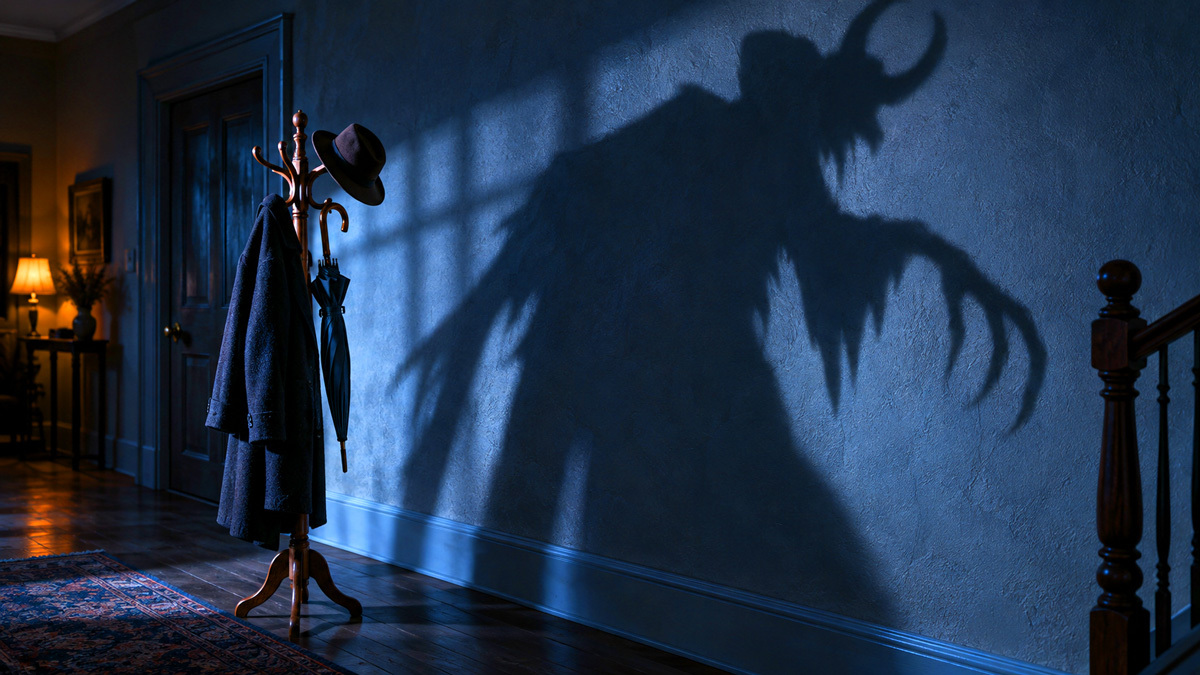
Halloween is the one month a year the whole world agrees to be a little unhinged in public. Yard skeletons are somehow twelve feet tall and playing volleyball. Someone at the office shows up as a shark eating a man in a rowboat, and nobody asks why. It’s understandable why Halloween is so many people’s favorite holiday.
But here’s what gets me every October. We’ll spend real money and real effort on fake fear, haunted houses, jump-scare movies, the works, and then walk straight out of that theater into a week of very real, entirely unpaid dread about a doctor’s appointment, a performance review, or an email we still haven’t opened.
We’re not short on imagination. Far from it. We use it to cook dinner out of three random fridge items, to picture a room before we’ve bought a single throw pillow, to write the perfect comeback to an argument that happened four years ago, usually around 2 a.m. Our imagination is working overtime. It just isn’t always working for us.
The Shark You Never Saw
Here’s a fact that’s stuck with me for years. While filming Jaws, Steven Spielberg’s mechanical shark kept breaking down. He couldn’t shoot it the way he’d planned, so he was forced to imply the shark instead, a fin, a point-of-view shot, that music, and let the audience’s imagination do the rest. Most people consider it scarier than if he’d shown the whole shark from scene one. Left to fill in the blanks, our brains will build something worse than what’s actually there almost every time.
Haunted houses run on the same trick. The scariest part usually isn’t the actor in the mask, it’s the ten seconds of dim hallway before you get there, when your own brain is doing the actual work. Theme park designers know this and stretch that hallway out on purpose, because anticipation almost always outperforms whatever they could actually put in the room.
That’s not a flaw in the system. That’s the whole feature. Imagination doesn’t come with a setting that says only use this for good. It’s a tool, full stop, and it’s just as willing to build your worst-case Tuesday as it is your dream kitchen. Given nothing else to work with, it will happily write a screenplay where you get the diagnosis, lose the client, or find out everyone’s been talking about you, all from one unread text message.
We’ve all had the night a weird symptom turned into a full internet-search spiral by 11 p.m. We’ve all rehearsed an entire argument with someone who has no idea it’s even happening, complete with our best lines and their stunned silence. That’s imagination too. It’s just aimed at the haunted house instead of the highlight reel.
We’re also the audience yelling “don’t go in the basement” at the screen, while doing the exact metaphorical version in our own lives, replaying the scary scenario instead of just calling the doctor, sending the email, or having the conversation. We know better for the character on screen. We forget to apply it to ourselves.
You’re Already the Director
Halloween is actually a great, low-stakes moment to notice this, because for one month a year we deliberately choose our fear. We pick the costume. We pick the movie. We know none of it is real, which is exactly why it’s fun instead of just scary.
The rest of the year, most of us aren’t choosing. We default. And whatever gets rehearsed the most, in the most vivid detail, on the most repeat, tends to start feeling less like a possibility and more like the plan.
So here’s the actual question worth sitting with this season: when it comes to the parts of your life that matter, are you picking the movie? Or just leaving the remote lying around for whoever grabs it first?
Where This Actually Shows Up
This isn’t about forcing positivity or pretending nothing bad ever happens. Real risk is real. It’s about noticing which script is currently running, and choosing, more often, to write a different one on purpose. A few ways this shows up in ordinary life:
- The relationship where we’ve already imagined the fight before we’ve even brought up the actual topic.
- The goal we’ve quietly shelved because we’ve imagined every way it could flop, but never once imagined it working.
- The health scare we’ve diagnosed ourselves with three separate times before we’ve called an actual doctor.
- The new opportunity we said yes to in our imagination for exactly four seconds, before switching the channel back to “what if I fail where people can see me.”
- The trip or plan we’ve quietly talked ourselves out of because we’ve pre-lived every version of it going wrong, weather, flights, budget, before we’ve even checked a single price.
None of that means ignoring real risk or real feelings. It means giving the possible version of the story equal screen time to the worst-case one, instead of running the disaster reel on a loop and calling it realism.
The Trailer Swap
Here’s a small practice I actually use on myself when I catch my imagination writing horror instead of hope. I call it the trailer swap:
- Catch the scene. Notice the movie currently playing in your head and name it plainly. “I’m imagining this conversation going badly” is enough.
- Ask who’s directing. Is this based on something that’s actually happened, or is it a script your imagination wrote entirely on its own?
- Cut a new trailer. Picture one specific, realistic version where it goes fine, or even goes well. Not a fantasy. Just a fair one.
- Run it a few times. The scary version got rehearsed into feeling true through repetition. The possible version deserves the same number of viewings.
It takes about ninety seconds. It’s not magic, and it doesn’t erase every legitimate worry. It’s just redirecting a tool we’re all already using constantly, toward something that actually serves us instead of something that just scares us.
There’s a reason actors run a scene dozens of times before it feels believable on stage. Repetition is what turns a script into something that feels true, a kind of muscle memory for the brain. The brain doesn’t check whether the script was ever a fact. It just runs whatever’s been performed the most, which means the version we practice is the one that starts to feel real, whether we meant to rehearse it or not.
Whatever we imagine on repeat, we start preparing for. Our nervous system, our choices, our whole posture in a room, all of it responds to the movie we keep replaying, whether or not we ever meant to write that particular one.
The power to imagine a version of your life you’re genuinely excited about was never missing. It’s the same imagination that’s been running the show the whole time, just pointed in a different direction. There’s a reason “main character energy” became such a popular idea online. It’s because something in us already knows we’re the one holding the pen. We just don’t always remember that it applies off-camera too.
This Halloween, enjoy every bit of the fake fear: the costumes, the candy, the neighbor’s alarmingly ambitious inflatable lawn display. And then, when it comes to the story you’re actually living, consider picking the pen back up.
If any of these spoke to you, I’d love to talk. I offer a free intro meeting where we can look at what’s really going on, what you actually want, and what a small, doable step forward could look like. No pressure, no pitch, no homework. Just an honest conversation about you and the story you’re actually ready to write next.
With love,
Coach D


